Role of Battery Cyclers in EV Battery Development
The rapid growth of electric vehicles (EVs) has increased the need for batteries that are safer, more reliable, efficient, and capable of delivering consistent performance over many years. Developing such batteries requires extensive testing at different stages, from individual cells to complete battery packs. This is where battery cyclers play an important role.
A battery cycler is a testing system used to repeatedly charge and discharge a battery under controlled conditions. It helps researchers and engineers understand how a battery performs under different electrical loads, temperatures, charging conditions, and operating cycles. The data collected through these tests supports battery development, performance improvement, quality control, and lifecycle evaluation.
For companies working on advanced battery technologies, understanding the role of battery cyclers in EV battery development is essential for creating dependable energy storage solutions.
Why Is Packaging Testing Important for UAE Exporters?
Different forms of stress may be encountered by goods in the supply chain process. Products may be stacked in warehouses, exposed to vibrations while in transit, and subject to handling, temperature and humidity variations.
The package that is strong enough for routine handling can collapse under such circumstances.
Package testing enables companies to test if the packaging material used is able to:
- Provide protection during shipment and storage
- Withstand stacking and compression
- Impact resistant
- Protection against leakages or contamination
- Provide structural integrity
- Protection against environment
- Comply with customer and applicable regulatory specifications
In the case of pre-packed products, UAE law may also deal with the accuracy of declared quantities and ways to determine actual quantities. For instance, Cabinet Resolution No. 83 of 2024 provides technical regulation regarding quantity control of pre-packed products, which includes provisions for inspection, sampling and measurements.
What Is a Battery Cycler?
A battery cycler is the type of laboratory instrument that is utilized to test and control battery charging and discharging processes. The battery cycler can deliver certain voltage or current and measure key parameters such as voltage, current, capacity, energy, temperature, and number of cycles.
Battery cyclers may be applied depending on the purpose of the testing for individual battery cells, modules, or whole battery packs. Contemporary battery cyclers provide exact measurements and test profiles that can be programmed.
Battery cyclers are widely used in research laboratories, battery manufacturing plants, car companies, universities, and energy storage research centers.
Role of Battery Cyclers in EV Battery Development
Battery cyclers are involved in several important stages of EV battery development. They provide measurable data that helps engineers understand battery behaviour and identify potential performance or reliability issues.
1. Battery Performance Testing
One of the primary uses of battery cyclers is evaluating battery performance. Engineers can measure the usable capacity, energy output, voltage behaviour, charging efficiency, and discharge characteristics of a battery.
Repeated testing helps determine whether a battery can consistently deliver the required performance under different operating conditions. This information is important when selecting and improving battery cells for electric vehicles.
2. Cycle Life and Battery Degradation Analysis
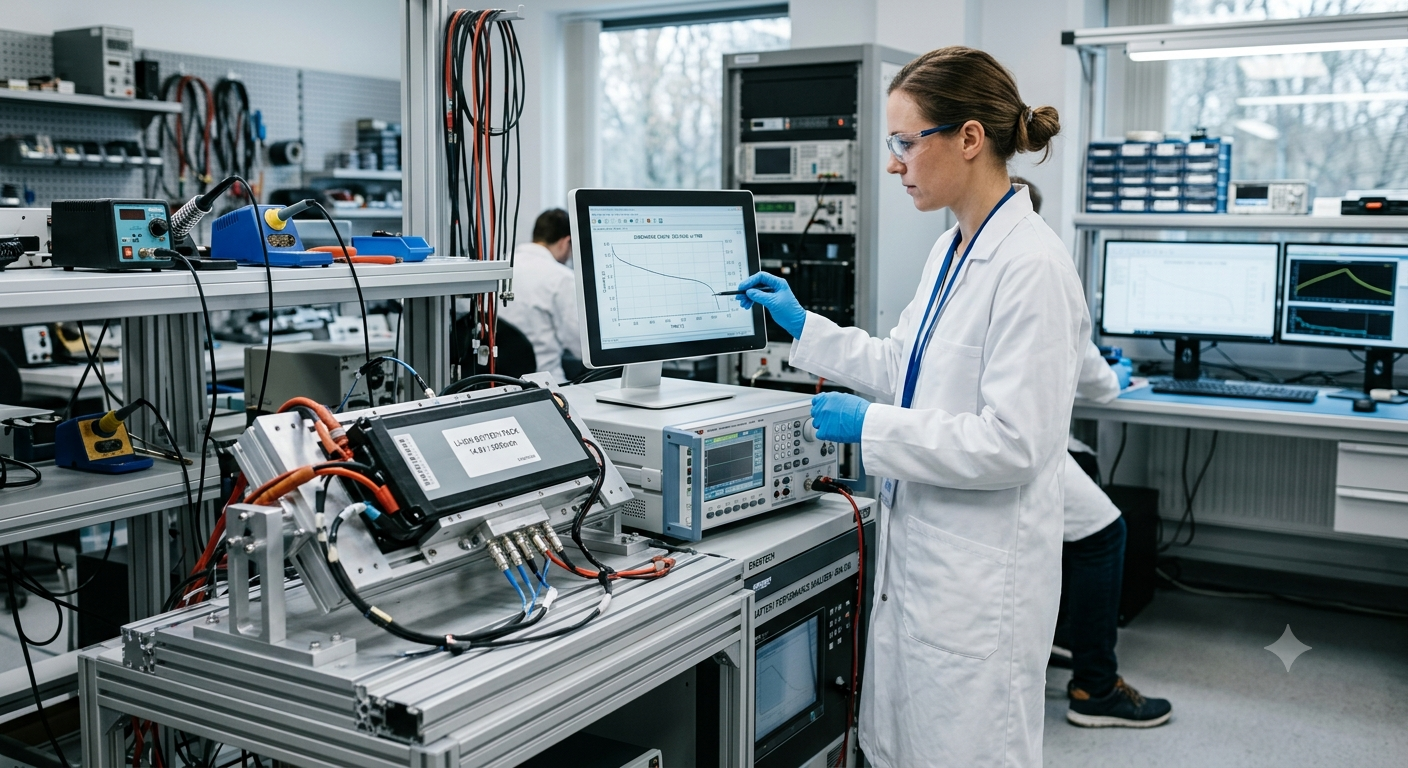
EV batteries are expected to operate through hundreds or thousands of charge-discharge cycles. Battery cyclers allow researchers to repeatedly cycle batteries and observe how their performance changes over time.
During long-term testing, engineers can identify capacity loss, changes in internal resistance, and other signs of degradation. This helps estimate battery lifespan and understand how different materials, cell designs, and operating conditions affect durability.
3. Testing Different Charging Conditions
Charging behavior is another factor that needs to be considered when designing batteries for electric vehicles. There are various types of charging behaviors such as slow charging, fast charging, partial charging, and others that batteries undergo throughout their life cycles.
Battery cyclers can simulate these different charging behaviors within a laboratory setting. This would enable engineers to understand how each affects the performance of the battery among other factors.
4. Safety and Reliability Evaluation
Battery safety is a major priority in electric vehicles. Testing equipment helps researchers monitor battery behaviour under controlled conditions and identify abnormal performance.
Battery cyclers can be integrated with temperature monitoring and other measurement systems to evaluate how batteries respond to different electrical loads and operating profiles. Such testing helps identify potential issues before battery systems move into larger-scale development or production.
5. Battery Management System Development
The Battery Management System (BMS) continuously monitors and controls important battery parameters such as voltage, current, temperature, and state of charge.
Battery cycler data can support the development and validation of BMS algorithms. Engineers can use controlled charge and discharge profiles to evaluate whether the BMS accurately estimates battery conditions and responds appropriately to different operating situations.
Why Accurate Battery Cycling Matters
The accuracy and repeatability of testing are critical in battery research. Small measurement errors can affect conclusions about battery capacity, efficiency, degradation, or lifespan.
Modern battery cyclers provide precise control over charging and discharging parameters while continuously recording test data. This allows researchers to compare different battery technologies under similar conditions.
Accurate testing can also reduce development time by helping engineers identify promising battery designs and eliminate less effective options earlier in the research process.
Applications Beyond EV Batteries
Although battery cyclers are strongly associated with electric vehicle research, their applications extend beyond automotive batteries. They are also used for lithium-ion battery research, energy storage systems, portable electronics, renewable energy storage, and other rechargeable battery technologies.
The same testing principles can help researchers evaluate battery performance, ageing, efficiency, and reliability across different applications.
Choosing the Right Battery Cycler
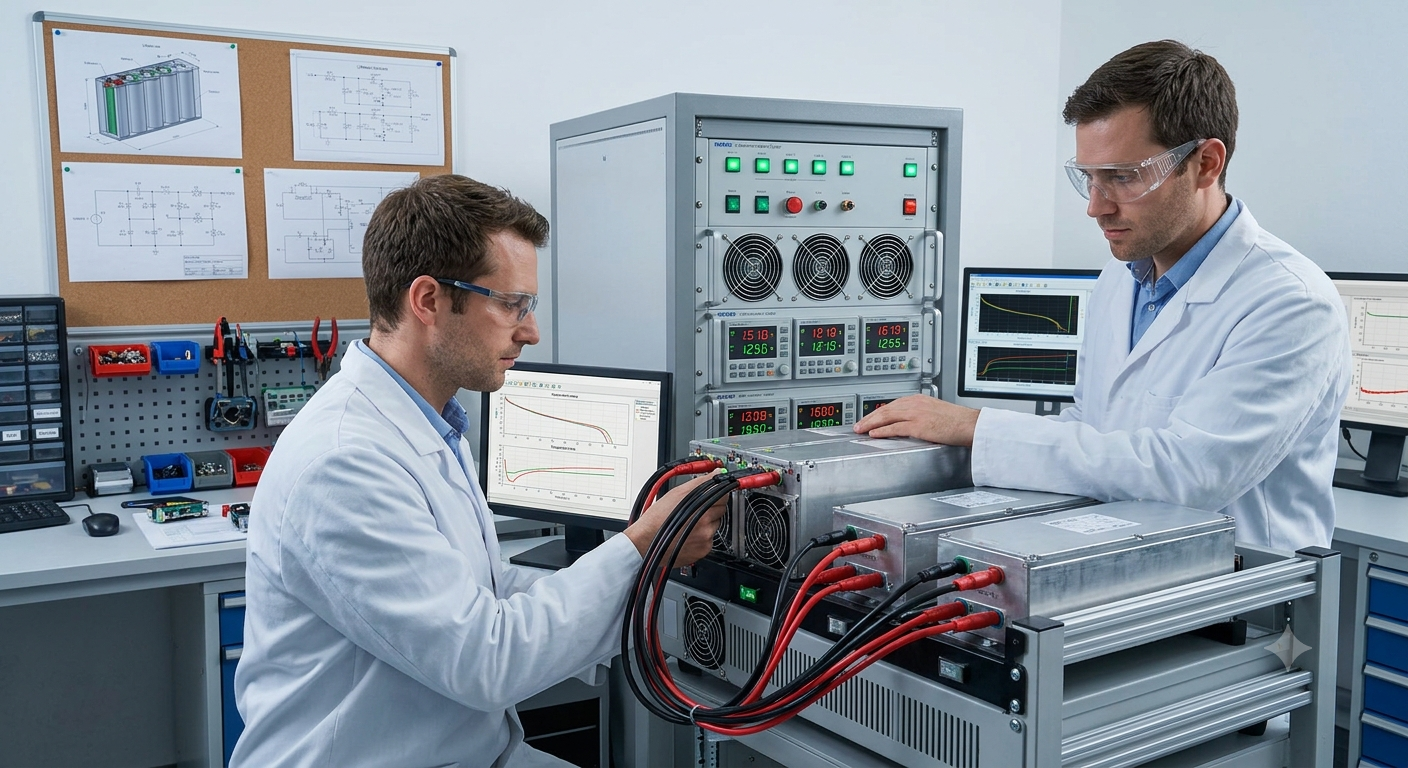
Selecting a suitable battery cycler depends on the type and scale of testing required. Important factors include voltage range, current capacity, number of channels, measurement accuracy, power capability, testing speed, software functionality, and safety features.
For advanced EV battery research, the testing system should also support programmable test profiles and reliable data acquisition. The right equipment allows laboratories to conduct repeatable experiments and generate useful results for research and development.
How Shivasscientific Supports Battery Testing Needs
Reliable testing equipment is an important part of successful battery research and development. Shivasscientific provides scientific and laboratory solutions that support researchers and organizations working with advanced testing requirements.
As battery technology continues to evolve, dependable testing systems can help laboratories collect accurate data, evaluate battery performance, and make informed development decisions. Choosing suitable equipment based on testing requirements is therefore an important step toward efficient and reliable battery research.
Conclusion
Testing of batteries is vital in the development of safe, long-lasting and efficient batteries for electric vehicles. Battery cyclers enable scientists and engineers to study in detail the behavior, lifespan, degradation, performance, and reliability of charging and discharging processes.
The role of battery cyclers in EV battery development will increase further as electric vehicle manufacturers and battery scientists work towards increasing energy density, improving charging speed, extending battery life and ensuring safety. The process of developing EV battery technology will be greatly aided by the use of accurate and repeatable tests to understand the battery behavior.
For those involved in battery research, the decision to invest in reliable testing equipment is an important step towards making sure that they get reliable results. Shivas scientific can be the right partner for any organization looking for scientific testing equipment that will meet their requirements.