
The selection of proper testing equipment plays a very important role in assessing the strength and performance of the materials. Among the several types of testing machines, Peel Strength Testing Machine and Tensile Testing Machine are two popular equipment that measure the strength of materials but work on different principles and applications.
Learning about the distinction between Peel Strength Testing Machine vs Tensile Testing Machine can be really helpful for manufacturers, quality control labs, packaging industry, etc.
A Peel Strength Testing Machine is designed to measure the force required to separate two bonded materials. The test is generally performed by pulling one material away from another at a specified angle and speed.
Peel testing is particularly important when evaluating products that depend on adhesives, heat seals, laminations, labels, tapes, films, and flexible packaging. The machine measures the force required to initiate and continue the separation, helping manufacturers determine whether a bond or seal meets the required quality standards.
For example, packaging manufacturers can use peel testing to evaluate the strength of heat-sealed pouches, laminated films, and other flexible packaging materials.
A peel strength tester can be useful in several industries, including:
Flexible packaging and food packaging
Adhesive and tape manufacturing
Plastic films and laminates
Labels and stickers
Medical packaging
Automotive components
Paper and board products
Pharmaceutical packaging
The test results can help identify weak bonding, inconsistent sealing, or variations in adhesive performance.
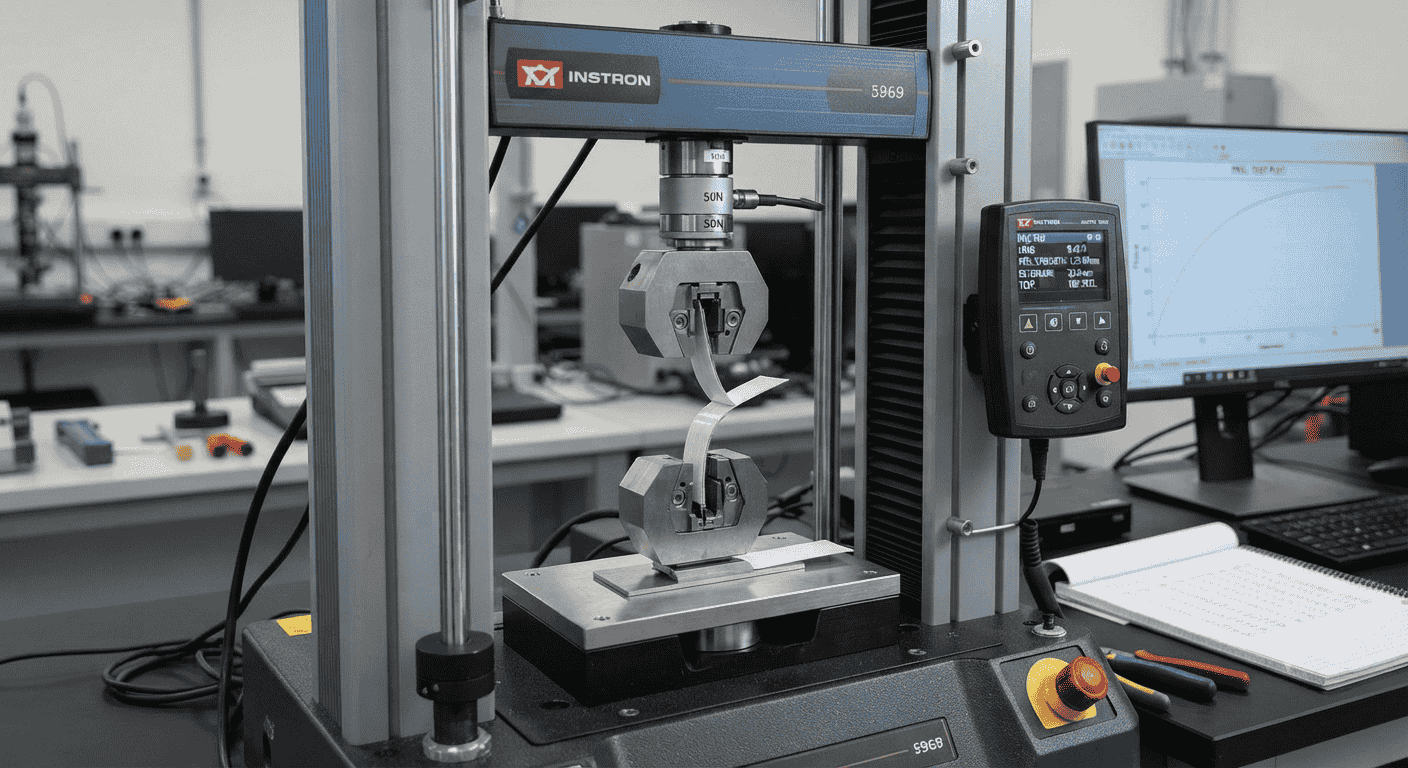
A Tensile Testing Machine, also known as a Universal Testing Machine (UTM) in many applications, is primarily used to determine how a material behaves when subjected to a pulling force.
During a tensile test, a specimen is securely held between two grips and pulled until it stretches or breaks. The machine records important parameters such as tensile strength, elongation, yield strength, and breaking force, depending on the material and test method.
Tensile testing can be performed on materials such as plastics, rubber, metals, textiles, paper, films, wires, and other manufactured products.
While both machines apply controlled force to a test specimen, their testing purposes are different.
| Feature | Peel Strength Testing Machine | Tensile Testing Machine |
|---|---|---|
| Primary purpose | Measures bond or seal separation strength | Measures resistance to tensile force |
| Typical test | Peel or seal-strength test | Tensile, elongation, and breaking test |
| Main application | Adhesives, laminates, seals, packaging | Plastics, rubber, metals, textiles, films |
| Test specimen | Usually bonded or sealed materials | Standardized material specimens |
| Force direction | Generally involves peeling/separation | Direct pulling or tension |
| Common result | Peel force or seal strength | Tensile strength, elongation, breaking force |
Therefore, the choice between the two depends mainly on what property you need to evaluate.
A peel tester is the better choice when the primary concern is the strength of a bond, adhesive joint, laminate, or packaging seal.
For instance, if a packaging manufacturer wants to determine whether a pouch seal can withstand handling and transportation, peel or seal-strength testing can provide valuable information. Similarly, adhesive manufacturers can use peel testing to compare the performance of different adhesive formulations.
A Peel Strength Testing Machine can also support quality control by helping manufacturers maintain consistent bonding and sealing performance across production batches.
A tensile testing machine is more appropriate when you need to understand the mechanical properties of the material itself.
For example, a plastic manufacturer may want to determine the tensile strength and elongation of a film. A rubber manufacturer may need to measure how much a specimen stretches before breaking. Textile manufacturers can also use tensile testing to evaluate the breaking strength of yarns or fabrics.
Because tensile testers can often accommodate different grips, fixtures, and test accessories, they can be adapted for testing a wide range of materials and products.
Not always. Although both machines measure force, their test configurations, fixtures, specimen arrangements, and testing objectives can be significantly different.
A tensile testing machine may be configured for certain peel or adhesion tests when the appropriate fixtures and standards are supported. However, laboratories that regularly perform dedicated peel-strength or seal-strength testing may benefit from equipment specifically designed for those applications.
The correct choice should therefore be based on the material, test standard, specimen geometry, required force range, and testing objective.
Before purchasing testing equipment, consider the following factors:
Material being tested: Identify whether you are testing packaging, adhesive, plastic, rubber, metal, textile, or another material.
Required test method: Determine whether your application requires peel, seal, tensile, elongation, or breaking-strength testing.
Applicable standards: Check the relevant ASTM, ISO, or industry-specific testing standard.
Force capacity: Select a machine with an appropriate load range for your specimens.
Test speed and accuracy: Consistent test speed and reliable force measurement are important for repeatable results.
Fixtures and accessories: Make sure the machine supports the grips or fixtures required for your specific test.
Data recording: Digital displays and software-based data acquisition can simplify analysis and reporting.
The difference between a Peel Strength Testing Machine vs Tensile Testing Machine ultimately comes down to the property you need to measure. Peel testing focuses primarily on the force required to separate bonded, laminated, or sealed materials, while tensile testing evaluates how a material responds to direct pulling forces.
Selecting the correct testing machine can improve quality control, support product development, and help manufacturers maintain consistency with applicable testing requirements.
Shivas scientific provides testing solutions designed to support reliable material and product evaluation across different industrial applications. Before selecting a machine, it is recommended to clearly define your testing requirements and applicable standards so that you can choose equipment suited to your laboratory or production environment.
Whether your requirement is adhesive and seal evaluation or mechanical strength testing, choosing the right testing method is the first step toward obtaining meaningful and repeatable test results.