Machine Learning for Battery Degradation Prediction: Improving Battery Life and Reliability in the UAE

Batteries have become extremely significant not only for electric cars but also for storing renewable energy, operating industrial machinery, and advanced energy management systems. Thus, in the light of growing use of batteries in the UAE, knowing the aging mechanisms of batteries becomes critical in terms of increasing efficiency and safety of operation.
In traditional battery testing, researchers can obtain information on capacities, charging process, and cycle life. However, making accurate predictions of future battery performance over several months or even years is rather complicated. In this respect, Machine Learning for Battery Degradation Prediction provides great opportunities. Applying machine learning algorithms to performance data, researchers can detect patterns of battery aging, evaluate its state, and make more informed decisions regarding the further use of batteries.
Such technologies can prove to be useful for laboratories, battery producers, and research institutions in the UAE.
What Is Battery Degradation Prediction?
Prediction of battery degradation refers to forecasting the deterioration of performance of a battery over a period of time. This happens due to changes in the physical and chemical properties of rechargeable batteries during the process of charging, discharging, and storing of these batteries.
Some of the common signs of battery degradation are decrease in capacity, increase in internal resistance, change in charge duration, and lower energy efficiency.
Prediction of battery degradation involves analyzing the previous test data along with applying mathematical models for forecasting. If machine learning is used in such a case, algorithms use previous data to recognize relationships between operating conditions of the battery and its degradation.
This helps in predicting the future life span of the battery based on its usage.
How Machine Learning for Battery Degradation Prediction Works
Machine learning allows computer models to analyse large amounts of battery data and identify patterns that may be difficult to detect through conventional analysis alone.
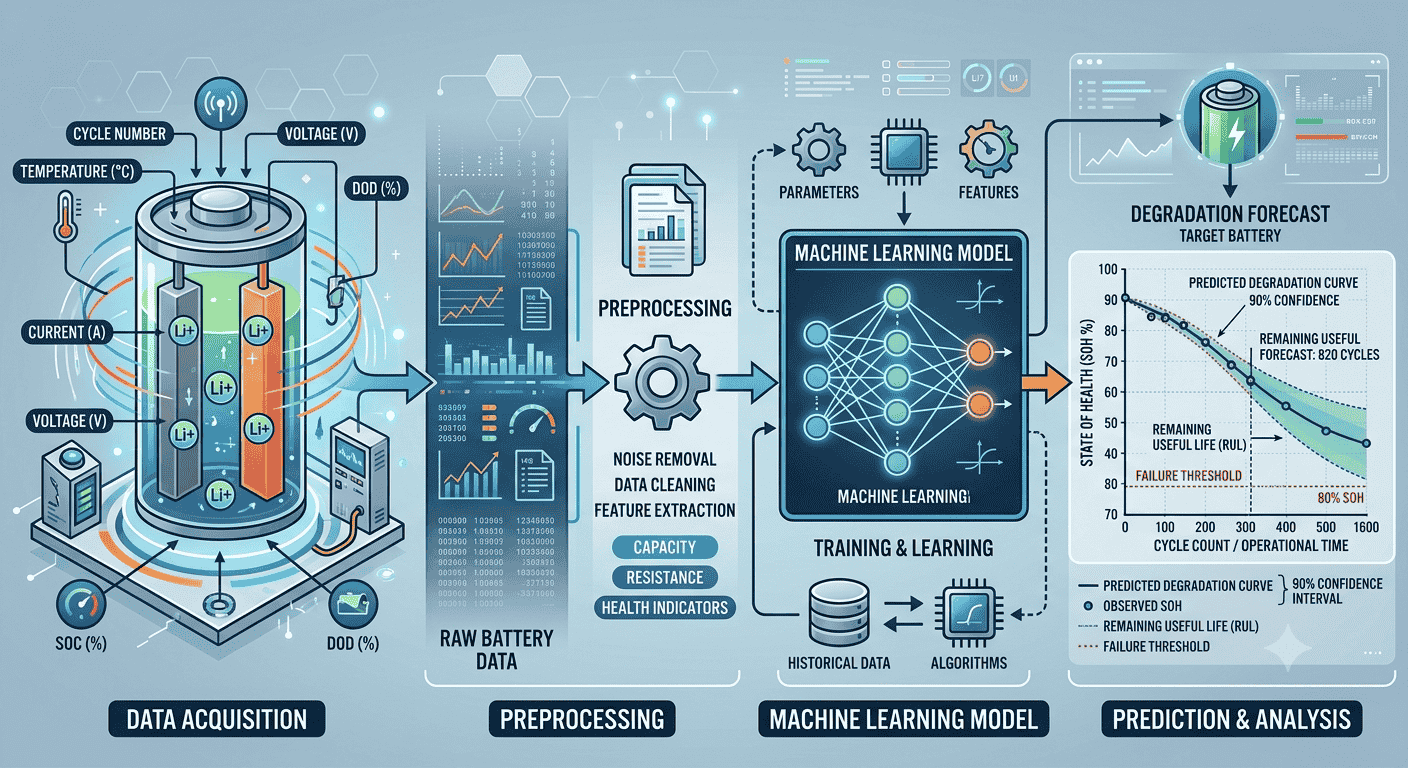
1. Collecting Battery Performance Data
The first step is gathering reliable data from battery testing systems. This may include voltage, current, temperature, charging and discharging cycles, capacity measurements, and internal resistance.
Battery cyclers are particularly useful because they can apply controlled testing profiles and record battery performance over repeated cycles. The quality and consistency of this data directly influence prediction accuracy.
2. Preparing and Analysing the Data
Prior to the modeling process, the researchers clean the data, deal with missing values, detect measurement errors, and choose the important features.
The most significant features could be cycle-by-cycle capacity degradation, temperature variations, charging rates, discharge depth, and voltage response variations.
Good data preprocessing helps machine learning algorithms recognize the right patterns rather than false ones.
3. Training Machine Learning Models
Researchers can use different algorithms depending on the battery type, available data, and prediction objective.
Common approaches include Random Forest, Support Vector Regression, gradient boosting, and neural networks. Time-series models may also be useful when predicting battery behaviour across repeated operating cycles.
Models are trained using historical battery data and evaluated against separate test data. This helps researchers determine how accurately the models predict battery degradation under conditions they have not previously encountered.
4. Predicting Battery Health and Remaining Life
Once trained and validated, a machine learning model can estimate battery health, future capacity loss, or remaining useful life.
These predictions can help engineers identify batteries that require further investigation and compare the expected durability of different battery designs.
However, prediction quality depends on the training data, model selection, testing conditions, and how closely real operating conditions match the available data.
Key Benefits of Machine Learning in Battery Research
Machine learning can improve several aspects of battery research and development.
- Early identification of degradation: Models can highlight patterns associated with declining battery performance before substantial capacity loss becomes evident.
- Improved maintenance planning: Battery health estimates can help organizations plan inspections and replacement activities more effectively.
- Better battery design: Researchers can compare how different materials, charging profiles, and operating temperatures influence battery ageing.
- Reduced testing effort: In suitable applications, predictive models can complement long-duration experiments and help researchers prioritize further testing.
- More informed decisions: Data-driven predictions provide additional evidence for evaluating battery performance and reliability.
Machine learning does not eliminate the need for physical battery testing. Instead, it works alongside established testing methods to provide a more complete understanding of battery behaviour.
Applications Across the UAE
The UAE’s growing interest in electric mobility, renewable energy, and energy storage creates opportunities for advanced battery testing and predictive analytics.
Electric Vehicles and Charging Infrastructure
Battery health prediction can help EV manufacturers, fleet operators, and service providers understand battery ageing under different driving and charging conditions. This information can support maintenance planning and battery performance evaluation.
Renewable Energy Storage
Solar energy storage systems depend on batteries that can operate reliably through repeated charging and discharging cycles. Predictive models can help estimate battery degradation and support better maintenance planning for energy storage installations.
Research Laboratories and Battery Testing Facilities
Laboratories in the UAE can combine battery cyclers, environmental monitoring equipment, and machine learning tools to study battery ageing under controlled conditions. These approaches can support research into lithium-ion batteries and emerging energy storage technologies.
Industrial Energy Management
Industrial facilities that rely on backup power and battery-based energy storage can use battery health estimates to support equipment reliability and replacement planning.
Challenges in Battery Degradation Prediction
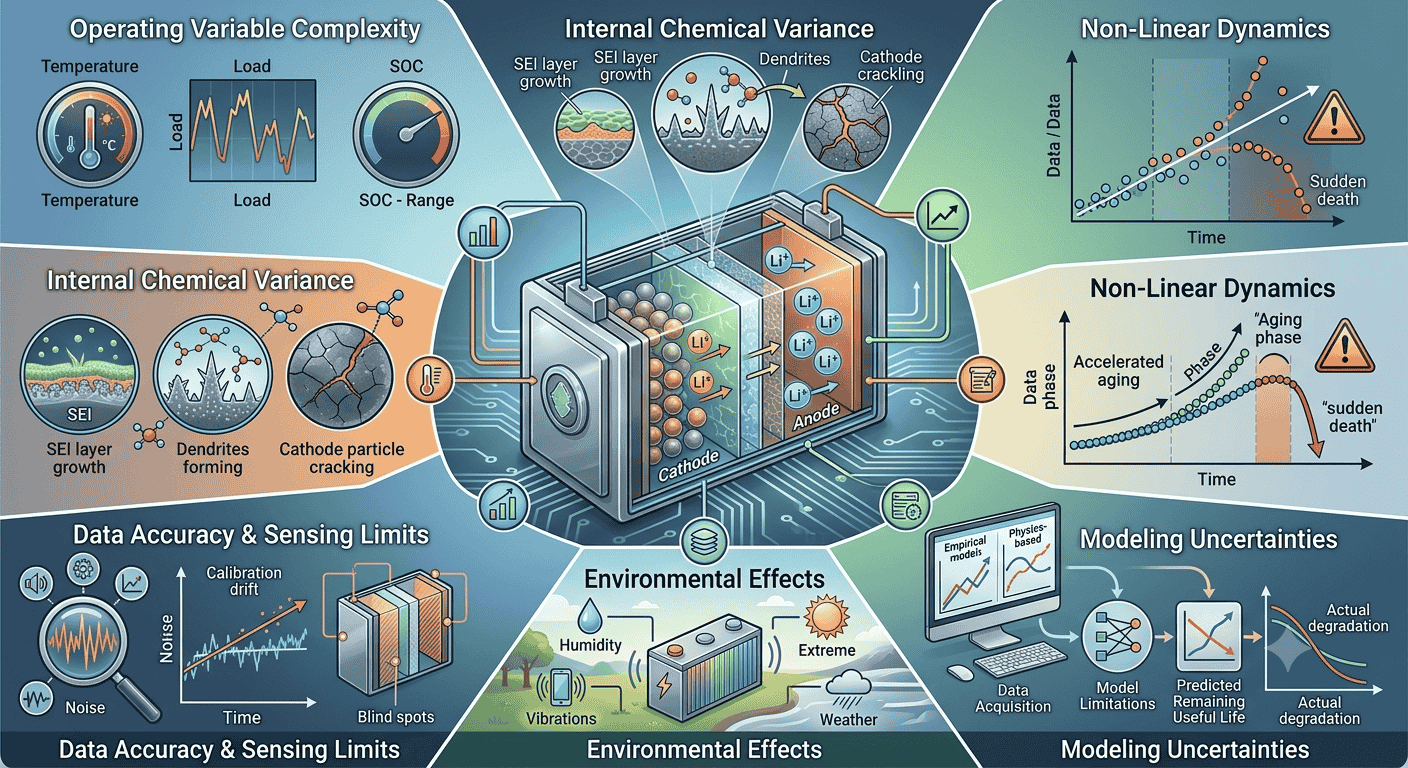
Machine-learning based predictions have their own limitations even though there are plenty of opportunities for development. Quality data is necessary to train models but gathering data from batteries with various types of chemistry, working conditions and age stages is time and resource consuming.
Models developed on the basis of one battery type may not work the same way for another battery. Fluctuations in temperature, non-uniform charging and differences between single cells may also influence the quality of predictions.
To overcome those problems, researchers need to check models’ performance through independent datasets, note the conditions of testing, measure errors and assess models’ performance periodically as new data appears.
The combination of machine-learning prediction with physical testing and existing battery analyses methods gives additional advantages.
How Shivasscientific Supports Battery Testing and Research
Laboratory equipment plays a crucial role in gathering the required information for analyzing battery performance and degradation.
Shivasscientific is a company that provides support to the scientific and laboratory testing needs by providing assistance in choosing the right testing equipment for their specific requirements.
Choosing the right battery testing equipment that has accurate measurement, programmable charge discharge cycles, and reliable data logging will provide a good basis for battery research for research laboratories and organizations conducting battery testing in the UAE.
With the right software and machine learning models, the data gathered from reliable testing equipment will be useful in understanding battery aging and performance.
Conclusion
Machine learning provides new insights into the process of understanding and predicting battery degradation based on the analysis of voltage, current, temperature, capacity and cycle life measurements.
The Machine Learning for Battery Degradation Prediction may be used for the efficient work in the field of electric vehicle batteries, renewable energy storage devices and advanced battery technologies in organizations operating in the UAE.
The accurate gathering of the data, right choice of the algorithm and regular testing of the results are necessary conditions for obtaining reliable predictions. With proper lab experiments
equipment and data-driven analysis, Shivasscientific can support organizations seeking practical scientific solutions for battery research and development