

Ultra-Fast EV Charging: The Electrochemical Challenges Behind It

Ultra-Fast EV Charging

The Electric Vehicle (EV) has come to revolutionize transportation in the current era due to its environment-friendly nature compared to fuel-based automobiles. As more electric cars are adopted on the roads, car users need efficient charging systems that will minimize the time of charging and make distant journeys easier. Such developments have made Ultra-Fast EV Charging a common technology among researchers and producers of electric cars.

However, the charging of such automobiles at very high energy levels is not just about feeding more power into the car. It has to do with the way the battery takes in the energy without experiencing much heating up or changes that may affect its performance in future.

What Is Ultra-Fast EV Charging?

Fast charging of EVs is the process of using fast charging technology for decreasing the time needed to charge an electric vehicle. Fast charging technology typically involves DC charging stations having the ability to provide energy at a rate of 150 kW or higher. However, the definition of such fast charging varies among manufacturers.

The actual charging time is affected by various factors such as the power of the charger, the capacity of the battery, battery chemistry, temperature, state of charge, and the capabilities of the vehicle for accepting charging.

It is important to understand that even though the charger can provide a lot of power, the vehicle will not constantly accept this power during charging.

The Electrochemical Challenges Behind Ultra-Fast EV Charging

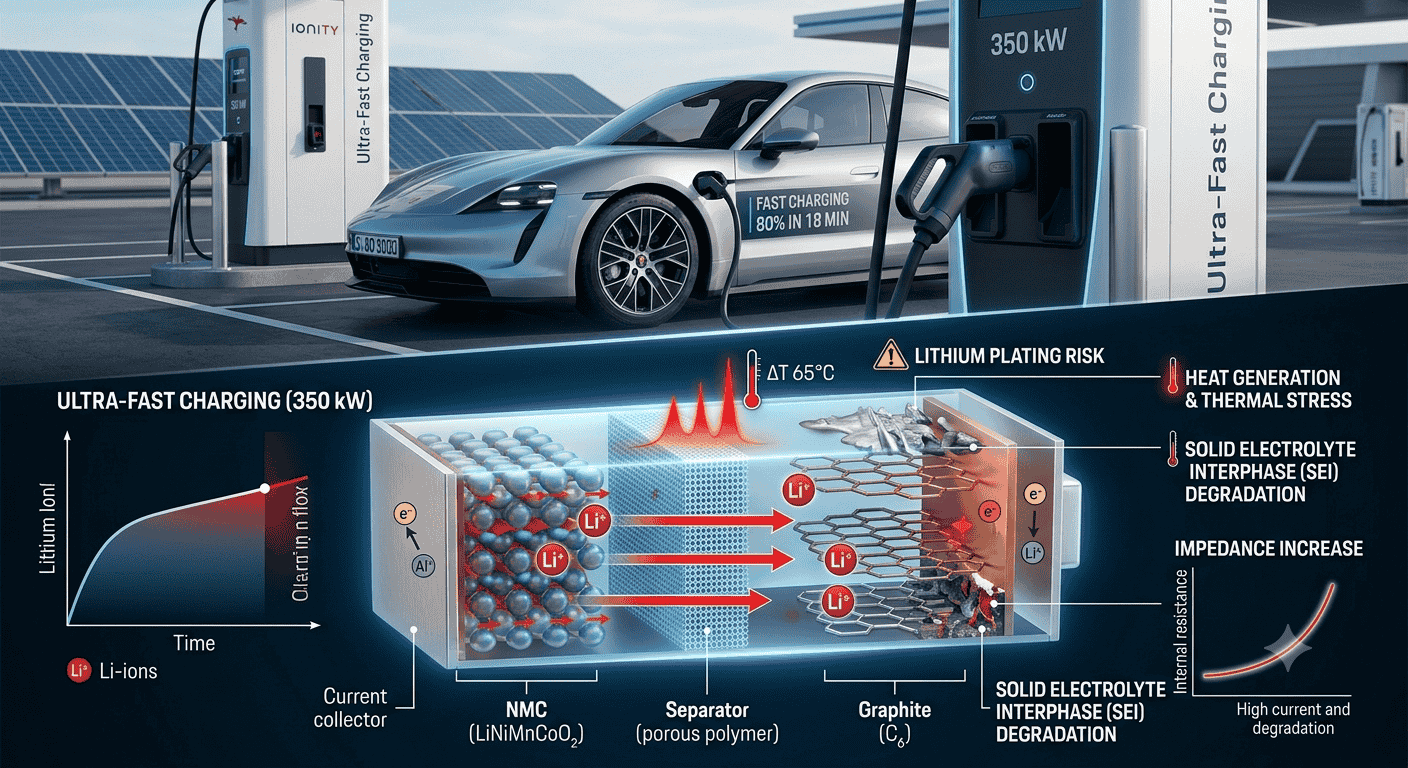
Lithium-ion batteries store and release energy through electrochemical reactions. During charging, lithium ions move from the positive electrode towards the negative electrode through the electrolyte, while electrons travel through the external circuit.

Increasing the charging rate places greater demands on these processes. Several technical challenges must be addressed to make fast charging reliable.

1. Lithium Plating on the Anode

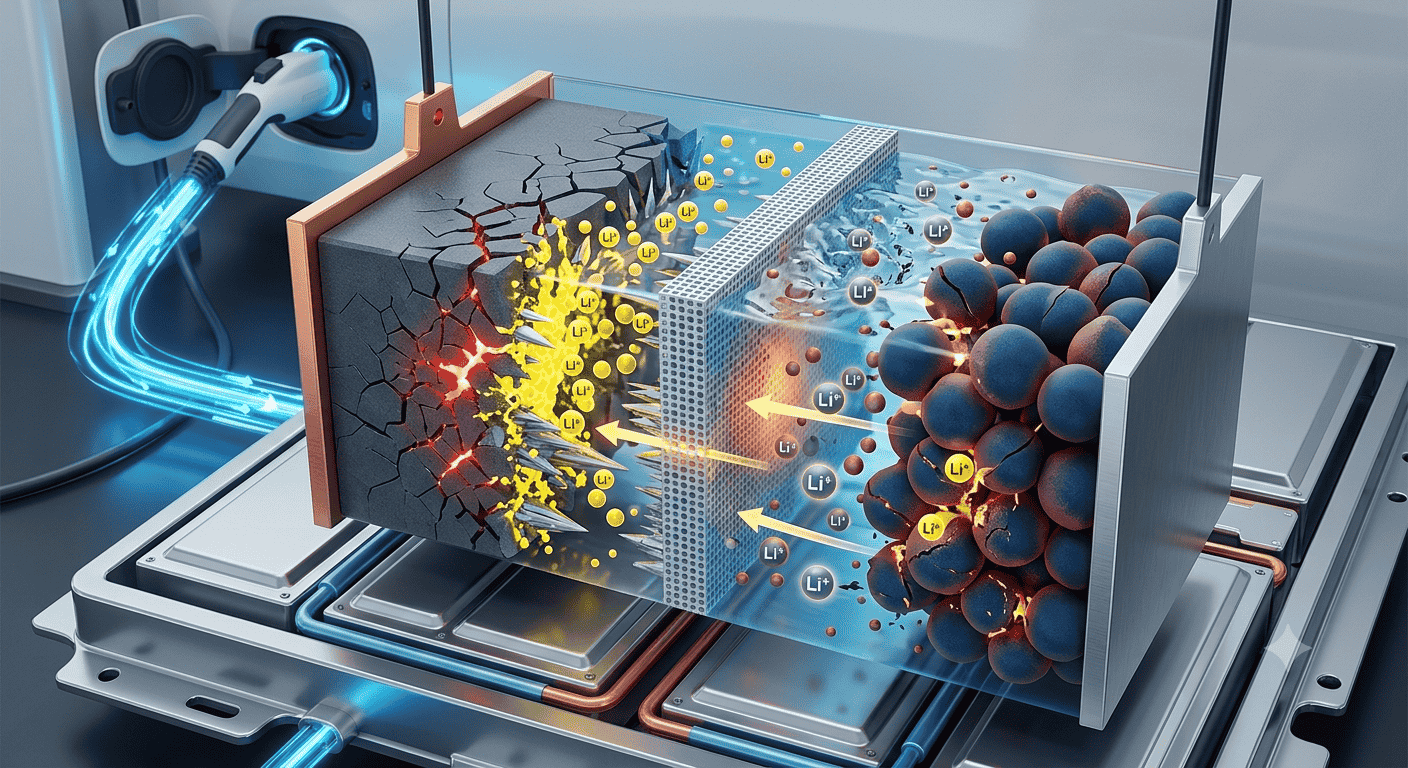
One of the major problems facing Li-ion batteries is that of lithium plating. In normal charging process, lithium ions migrate into the graphite anode where they are embedded. However, at high charge rates, there can be more lithium ions migrating into the anode than the number of ions the anode can hold.

In some cases, lithium ions form metallic lithium and plate on the anode rather than embedding in the graphite. Such a situation is called lithium plating.

Lithium plating lowers the effective battery capacity and accelerates degradation, while in serious cases, it can cause internal short circuits.

There have been many studies aimed at addressing the problem of lithium plating.

2. Heat Generation and Thermal Management

High charging currents increase heat generation inside battery cells. Some heat results from electrical resistance, while additional heat can arise from electrochemical processes.

Excessive temperature can accelerate unwanted chemical reactions, damage battery components, and shorten battery lifespan. Uneven temperature distribution across a battery pack may also cause individual cells to age at different rates.

Effective thermal management is therefore essential. Liquid cooling systems, improved cell designs, temperature sensors, and carefully controlled charging strategies help maintain suitable operating temperatures.

3. Ion Transport and Electrochemical Resistance

Ultra-fast charging requires lithium ions to move rapidly through the electrolyte and electrode materials. However, ion transport is limited by factors such as electrolyte conductivity, electrode thickness, porosity, and diffusion rates.

At high charging rates, concentration gradients can develop within the electrodes. These gradients increase polarization and may cause the battery voltage to reach its upper limit before the cell is fully charged.

Researchers are exploring improved electrolyte formulations, electrode structures, and material designs to support faster ion transport while preserving battery stability.

4. Battery Degradation and Cycle Life

Repetitive high rate charging has the potential of hastening battery ageing if the operating conditions are not well managed. Battery ageing could be caused by lithium plating, excessive heating, mechanical stress, and undesired chemical reactions.  

In the case of electric vehicle (EV) manufacturing companies, there exists a trade-off between fast charging and battery longevity.

Fast charging and optimized charging patterns are some of the ways that could be used to address this problem. An example could be where the battery accepts a high rate of current when charged at low SOC and decreases the current as it gets fully charged.
Ultra-Fast EV Charging

The Role of Battery Testing in Fast-Charging Research

Laboratory testing helps researchers understand how batteries respond to different charging rates and operating conditions before new technologies are introduced into commercial vehicles.

Battery cyclers allow engineers to apply controlled charge-discharge profiles and record parameters such as voltage, current, capacity, energy, and cycle count. This information helps researchers compare battery performance at different charging rates.

Environmental chambers and temperature monitoring systems can provide additional insight into battery behaviour under different thermal conditions.

Testing can help identify:

  • Changes in battery capacity during repeated fast-charging cycles.
  • Temperature increases under high-current conditions.
  • Signs of accelerated degradation.
  • Differences in performance between battery cells and designs.
  • The effects of charging protocols on efficiency and cycle life.

Reliable measurements are important because they help researchers distinguish genuine performance improvements from variations caused by testing conditions.

How Battery Management Systems Improve Charging Safety

The BMS measures various parameters related to battery voltage, current, and temperature. In fast charging, this information is used by the BMS to figure out the maximum allowable current for charging.

The BMS may reduce the amount of current used to charge the battery based on whether the battery gets too hot, near the battery voltage extremes, and in situations where increased degradation could be caused.

More sophisticated control methods can involve modeling the battery and estimating its state of health, which may influence the charging process. Yet, safety of the process requires reliable measurements and validated control algorithms.

Future Developments in EV Fast-Charging Technology

Ongoing research is focused on improving battery materials, thermal management, charging infrastructure, and predictive control systems. Silicon-enhanced anodes, advanced electrolytes, improved electrode architectures, and selected solid-state battery designs are being investigated for their potential to improve charging performance.

Not every emerging technology is commercially mature, and improvements depend on the complete battery design rather than a single material or component.

As these technologies develop, accurate laboratory testing will remain essential for evaluating charging speed, safety, energy efficiency, and long-term durability.
Ultra-Fast EV Charging

How Shivasscientific Supports Battery Research

Developing faster-charging batteries requires dependable scientific testing and reliable performance data. Shivasscientific supports scientific and laboratory testing requirements by helping organizations explore equipment suited to their testing applications.

For laboratories researching EV batteries, appropriate battery testing systems can help measure charge-discharge behaviour, evaluate capacity changes, and study performance under different operating conditions.

Selecting equipment with suitable voltage and current ranges, measurement accuracy, programmable test profiles, and data-recording capabilities is an important step towards conducting repeatable battery research.

Conclusion

The technology of ultra-fast charging can have a positive impact on the usability of electric vehicles, but there are many electrochemical difficulties that need to be dealt with. Lithium plating, heat production, ion mobility issues, and faster deterioration all require special attention.

Through the use of high-quality battery materials, appropriate battery management, and proper laboratory testing, one can strive for improved charging technology.

In the process of research and development of batteries, Shivasscientific can be a useful source of information regarding appropriate scientific testing equipment.