Packaging Testing Requirements for UAE Exporters
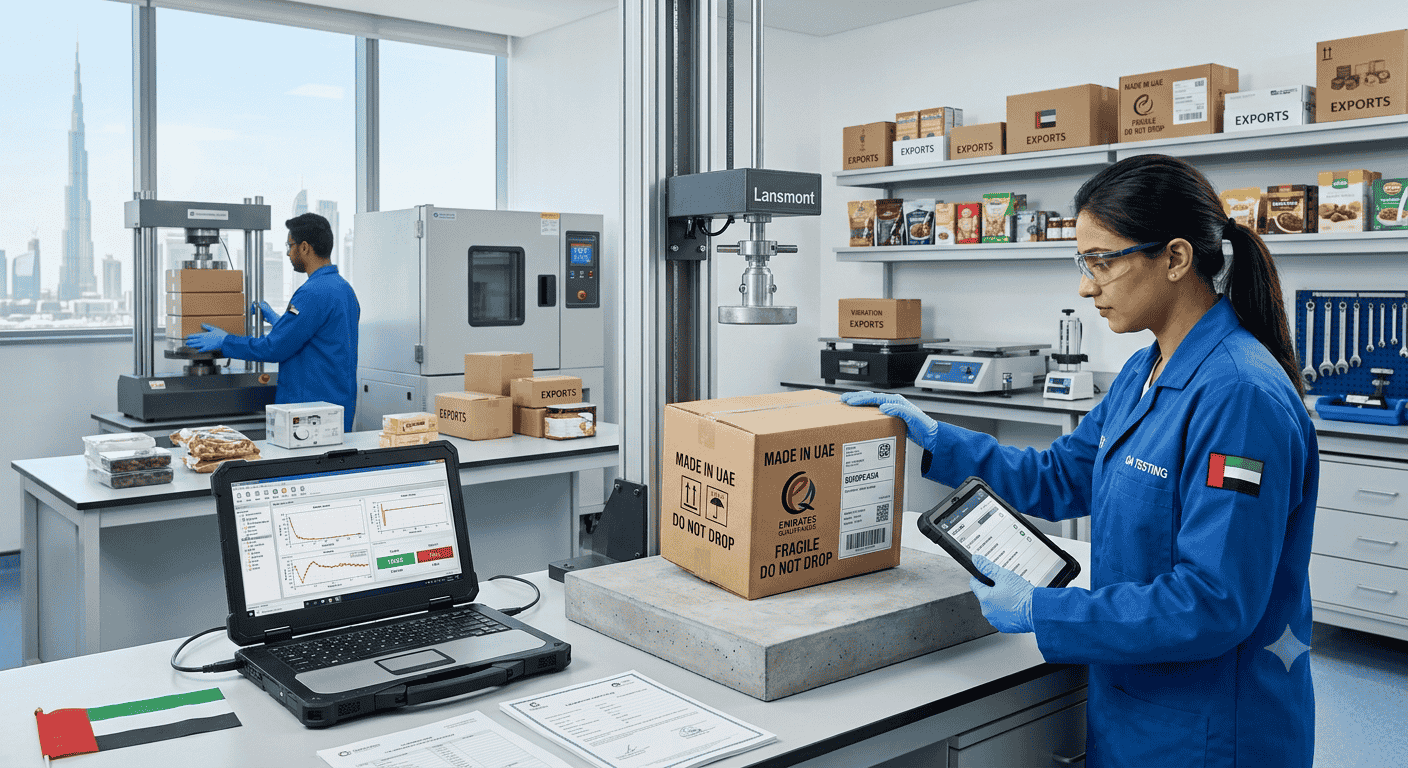
In business dealing with the exportation of goods into or from the UAE, packaging becomes more than just a means of protecting the product. Packaging has an integral part to play in ensuring product quality, protection against damage, transport-related issues as well as compliance with relevant regulatory and customer standards. The Packaging Testing Requirements for UAE Exporters can be different according to product type, material, transport conditions and relevant UAE or GCC Standards which may require standards related to specifications, safety, testing, packaging, labeling and marking.
For the exporter, testing the packaging prior to shipping can prevent product damage, customer complaints, returned shipments and unnecessary costs.
Why Is Packaging Testing Important for UAE Exporters?
Different forms of stress may be encountered by goods in the supply chain process. Products may be stacked in warehouses, exposed to vibrations while in transit, and subject to handling, temperature and humidity variations.
The package that is strong enough for routine handling can collapse under such circumstances.
Package testing enables companies to test if the packaging material used is able to:
- Provide protection during shipment and storage
- Withstand stacking and compression
- Impact resistant
- Protection against leakages or contamination
- Provide structural integrity
- Protection against environment
- Comply with customer and applicable regulatory specifications
In the case of pre-packed products, UAE law may also deal with the accuracy of declared quantities and ways to determine actual quantities. For instance, Cabinet Resolution No. 83 of 2024 provides technical regulation regarding quantity control of pre-packed products, which includes provisions for inspection, sampling and measurements.
Key Packaging Testing Requirements for UAE Exporters
There is no single packaging test that applies to every exported product. The appropriate testing programme should be selected according to the packaging design, product characteristics and expected distribution conditions.
1. Drop and Impact Testing
Drop testing evaluates how well a package protects its contents when it is accidentally dropped during handling.
This test can identify weaknesses in:
- Cartons and boxes
- Protective inserts
- Sealing systems
- Cushioning materials
- Outer packaging
It is particularly useful for products that are handled frequently during warehousing and transportation.
2. Compression Testing
Compression testing measures the ability of packaging to withstand pressure.
During transportation and storage, packages may be stacked on top of one another. Insufficient compression strength can result in crushed cartons, damaged products or unstable pallet loads.
Compression testing can help exporters determine whether their packaging can withstand expected stacking loads.
3. Vibration Testing
Transportation can expose packaged products to continuous vibration. Road, sea and air transportation can all create different vibration conditions.
Vibration testing helps identify problems such as:
- Loose components
- Product movement inside the package
- Seal failure
- Abrasion
- Structural damage
Testing can help businesses improve packaging before products are transported over long distances.
4. Environmental and Climate Testing
UAE supply chains can involve exposure to heat and humidity. Depending on the product and packaging, environmental testing may therefore be an important part of packaging evaluation.
Temperature and humidity testing can help assess whether packaging materials maintain their performance under expected storage and transportation conditions.
The required conditions should be selected according to the product, packaging material and applicable standard rather than using the same test conditions for every shipment.
5. Packaging Material Testing
The packaging material itself may require testing before it is used for export products.
Depending on the material, testing may evaluate characteristics such as:
- Thickness
- Strength
- Tensile properties
- Puncture resistance
- Tear resistance
- Moisture resistance
- Seal strength
- Barrier performance
The appropriate tests depend on whether the packaging is made from paper, paperboard, plastic, glass, metal or a combination of materials.
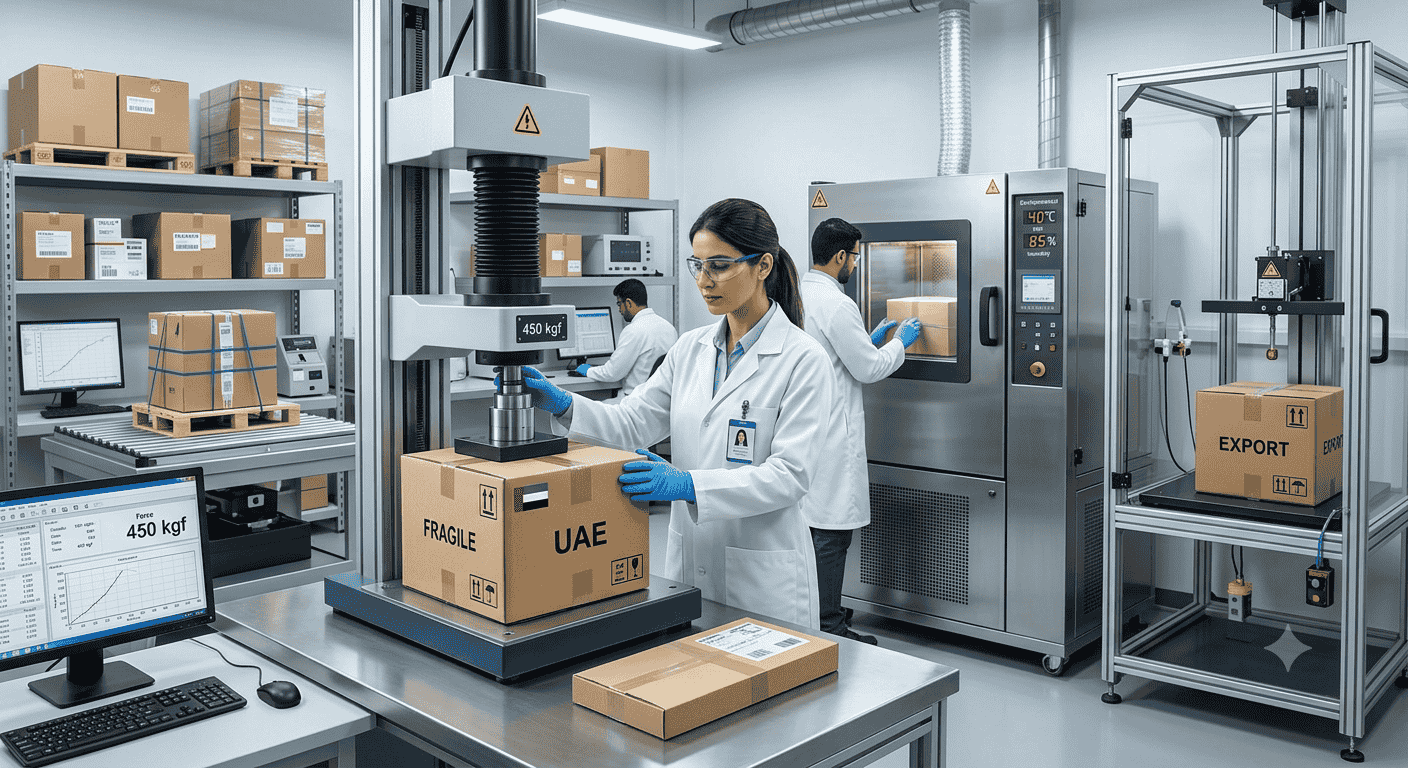
Testing Packaging According to Applicable Standards
One of the major steps in exporting products from UAE would be to determine the technical requirements or standards that pertain to the product being exported.
Standards and conformity assessments are used for regulated products under the UAE regulatory authority. If the product falls under the category of technical regulations, a Certificate of Conformity may need some supporting documents like test results from an accredited laboratory.
Thus, it would be important for the exporter to know the relevant standard applicable in UAE or GCC or internationally before deciding on packaging tests.
For instance, while packaging and labeling of food products may be more specific than that of general industrial products, information related to product identification, date, country of origin, net contents, etc. is needed.
Choosing the Right Packaging Testing Laboratory
Selecting a competent testing laboratory is an important part of the packaging quality process. Exporters should consider whether the laboratory has the appropriate testing capability, equipment and accreditation for the required tests.
ISO/IEC 17025 is the international standard used for the competence of testing and calibration laboratories. UAE’s national accreditation framework also covers laboratories according to ISO/IEC 17025.
A suitable testing process generally involves:
- Identifying the product and packaging type
- Understanding the distribution and transportation conditions
- Identifying applicable standards
- Selecting relevant packaging tests
- Preparing representative samples
- Conducting laboratory testing
- Reviewing the test results
- Improving the packaging design where necessary
- Maintaining testing and quality records
How Shivas Scientific Can Support Packaging Testing
Reliable packaging performance starts with selecting appropriate testing methods and evaluating packaging under relevant conditions. Shivas Scientific supports businesses looking for testing equipment and laboratory solutions for packaging and material evaluation.
The right testing approach can help exporters identify packaging weaknesses before products reach customers, warehouses or distribution centres.

Final Thoughts
Understanding Packaging Testing Requirements for UAE Exporters is very important for companies wishing to preserve the quality of their products during transportation. Drop, compression, vibration, environmental and materials testing can assist businesses in assessing different features of packaging performance.
Nevertheless, the selection of tests depends upon the type of the product, packaging materials used and transportation conditions and should comply with UAE or international standards. Cooperation with relevant testing equipment and labs will enable businesses to improve their quality control system and properly prepare their packages for difficult transportation conditions.
If you need assistance in choosing suitable testing equipment for your packaging or materials testing needs, you can get expert advice from Shivas Scientific.